
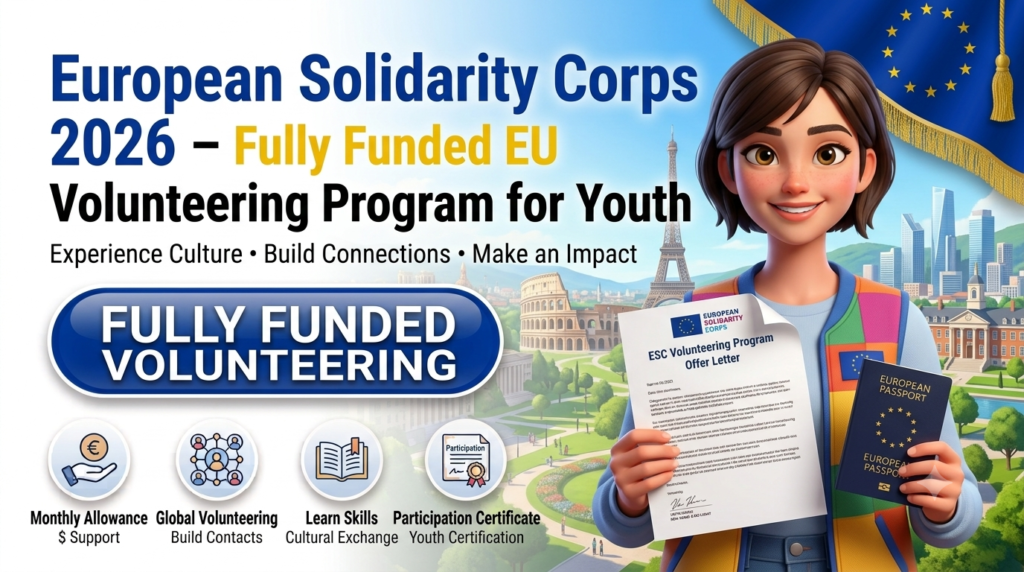
If you’ve ever wanted to live in Europe, support local communities, and gain international experience without paying for the opportunity yourself, the European Solidarity Corps (ESC) 2026 is definitely worth exploring. Unlike many posts that simply mention “volunteering in Europe” without explaining how it works, this guide covers the official EU programme, what it offers, who can apply, and how to get started.
What Is the European Solidarity Corps?
The European Solidarity Corps is an official initiative funded by the European Commission that gives young people the opportunity to participate in solidarity and volunteering projects across Europe and selected partner countries. Rather than being a one-time event or scholarship, it is a long-running programme that has been operating since 2016, supporting projects related to social inclusion, education, environmental protection, healthcare, humanitarian aid, democratic participation, and other community-focused activities.
Since its launch, the programme has supported more than 150,000 young people through over 22,000 projects. For 2026, the European Commission has allocated €175.3 million, making it the largest annual budget in the programme’s history. This continued investment means thousands of volunteering opportunities become available throughout the year.
European Solidarity Corps 2026 – Quick Overview
Organized By: European Commission
Programme Type: Fully Funded Volunteering
Eligible Locations: EU Member States, Iceland, Liechtenstein, North Macedonia, Norway, and Türkiye
Age Requirement: 18–30 years (up to 35 for humanitarian aid projects)
Project Length: 2 weeks to 12 months
2026 Programme Budget: €175.3 million
Application System: Rolling applications throughout the year
Application Fee: Free
Why Consider the European Solidarity Corps?
Many websites mention volunteering opportunities in Europe but don’t explain the official programme behind them. The European Solidarity Corps stands out because:
Most projects do not require a university degree or previous volunteering experience.
The programme is managed directly by the European Commission rather than a private organization.
Essential expenses—including travel, accommodation, meals, insurance, and pocket money—are covered.
Opportunities are available in a wide variety of countries and project areas, allowing participants to apply for projects that match their own interests.
Who Can Apply?
The programme has relatively straightforward eligibility requirements. According to the official guidelines, applicants must:
Be between 18 and 30 years old for standard volunteering projects. You may register from age 17, provided you meet the age requirement before your activity begins.
Be up to 35 years old if applying for humanitarian aid volunteering opportunities.
Legally reside in an EU Member State or one of the participating partner countries, including Iceland, Liechtenstein, North Macedonia, Norway, or Türkiye.
Have the motivation to contribute and learn. Most projects do not require specific educational qualifications or previous volunteering experience.
The programme also encourages applications from young people facing financial, social, geographic, or accessibility challenges. Additional support, such as mentoring, accessibility arrangements, or assistance with certain visa-related costs, may be available where appropriate.
What Does the Programme Cover?
Successful participants receive financial and practical support throughout their volunteering experience. Depending on the project, benefits generally include:
Reimbursement of travel expenses within programme limits.
Accommodation for the full duration of the placement.
Meals or a food allowance.
Comprehensive insurance coverage.
Daily pocket money for personal expenses, with the amount varying by country.
Language learning and skills training before and during the project.
An official certificate recognizing your participation.
It’s important to understand that this is a volunteering programme, not paid employment. Participants do not receive a salary. The pocket money is intended for everyday personal expenses while your major living costs are covered by the programme.
How to Apply for the European Solidarity Corps 2026
The application process is completed online and follows these steps:
Create an EU Login account through the European Commission’s authentication system.
Register on the European Solidarity Corps portal using your EU Login account.
Complete your volunteer profile by adding your interests, skills, availability, and preferred project areas.
Browse available projects through your dashboard, where new opportunities are published regularly.
Apply directly to projects that match your interests and eligibility.
Participate in interviews or additional selection stages if requested by the host organization.
Once selected, complete the required pre-departure training before beginning your placement.
Since projects are posted throughout the year, it’s generally a good idea to register early, keep your profile updated, and apply to multiple opportunities rather than waiting for a single project.
How Competitive Is It?
Competition for European Solidarity Corps placements remains high. Based on official programme information, demand has consistently exceeded the number of available placements, with only a portion of registered participants ultimately securing a project.
This doesn’t mean your chances are low if you apply carefully. Building a detailed profile, applying to several suitable projects, and tailoring your applications to each opportunity can significantly improve your prospects.
Frequently Asked Questions
Is the European Solidarity Corps free?
Yes. Registration and project applications are completely free. Legitimate ESC projects do not charge application or participation fees.
Do I need to know another European language?
No. Many projects do not require previous language knowledge, and language support is often included as part of the programme.
Can I choose where I want to volunteer?
Yes. Participants can browse available projects and apply for opportunities in countries that interest them, although final selection depends on the host organization.
Is this an internship?
No. The European Solidarity Corps is a volunteering programme rather than paid employment. While your living costs are covered, you do not receive a salary.
Should You Apply?
If you’re interested in meaningful international volunteering, cultural exchange, and contributing to local communities, the European Solidarity Corps is one of the strongest opportunities available. With no application fee, no degree requirement for most projects, and financial support covering the main costs of participation, it offers an accessible way for young people to gain valuable international experience while making a positive impact.
Official Programme Page: European Solidarity Corps – European Commission
Disclaimer: ScholarVerse publishes information about scholarships, fellowships, internships, and other international opportunities for informational purposes only. Although we make every effort to verify details using official sources, application deadlines, eligibility requirements, and programme policies may change over time. We strongly recommend checking the official White House website for the most up-to-date information before submitting your application.